


Unlocking The Secrets of Balancing The Chakras: Podcast Episode 4
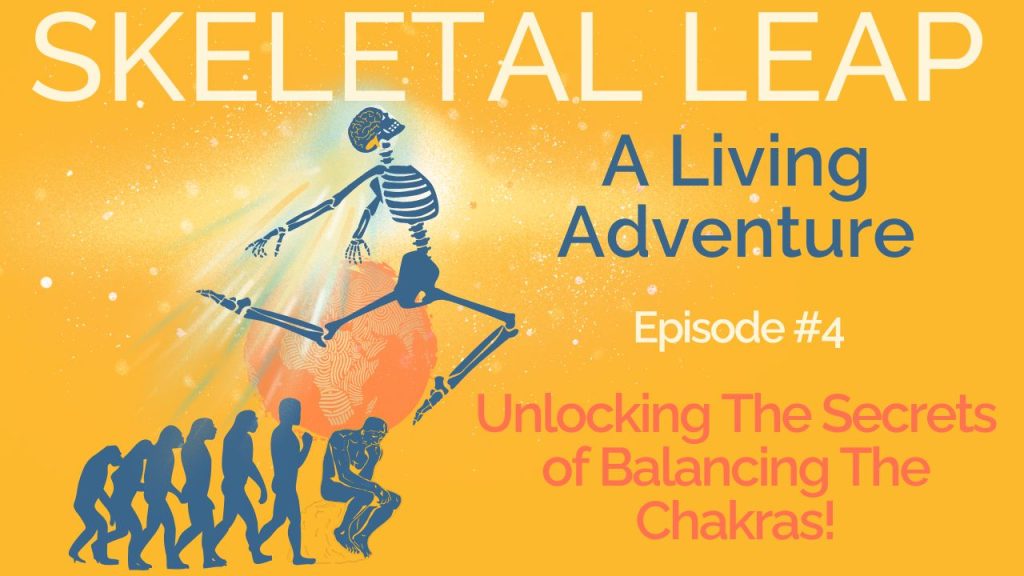
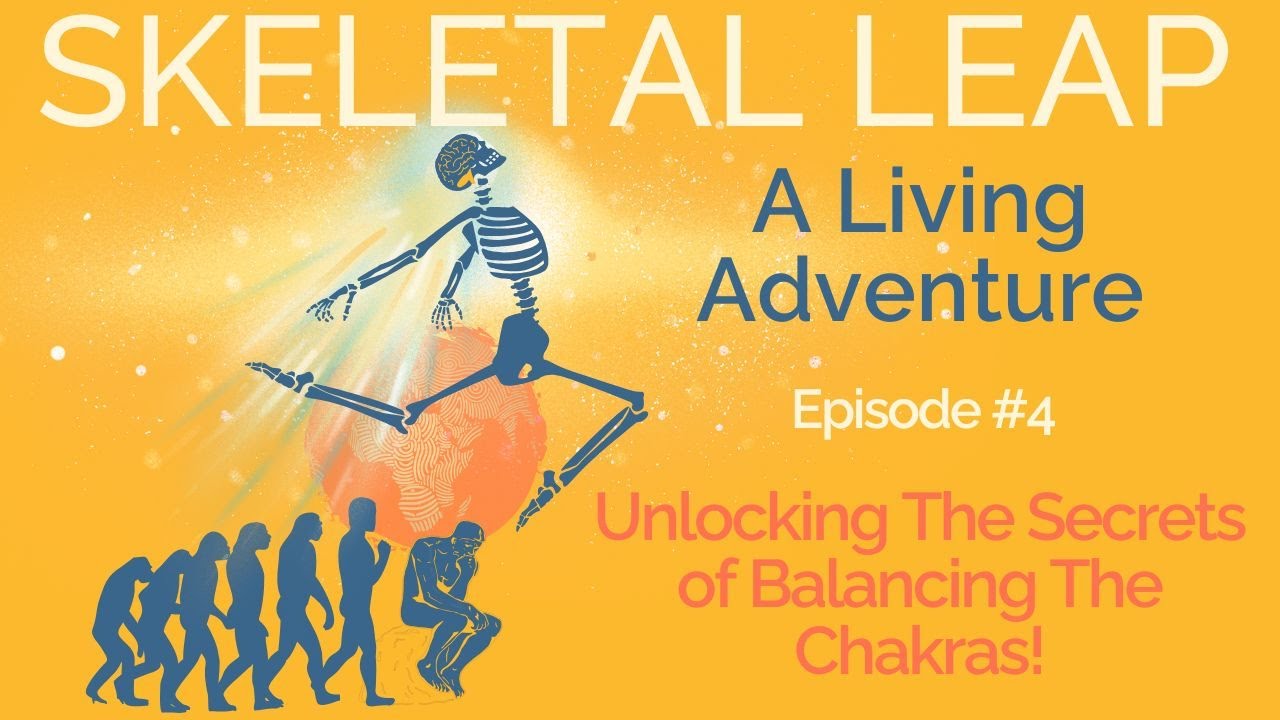
I am back with the 4th episode titled “Unlocking The Secrets of Balancing The Chakras: Podcast Episode 4” of my podcast Skeletal Leap: A Living Adventure.
SKELETAL LEAP, the mind body connection for mind and body healing, is a giant leap that our skeleton can take through the way it postures its joints.
I had stumbled upon this miracle many years ago, coincidentally.
It took me quite a few years to analyze it fully, and then a few more to turn the results of my analysis into a feasible action plan.
And now, SKELETAL LEAP is that feasible action plan for self healing, resulting in mental health and wellness as well as physical health and fitness.
I come up with a new weekly episode every Sunday morning for miraculous healing enthusiasts to start their weekly off-days with what they like the most!
Today’s episode “Unlocking The Secrets of Balancing The Chakras” will tell you how and why I decided not to stop after cracking the code of instant visual acuity and kept trying to crack more codes as I had an ancient esoteric system of faith yet untouched by scientific investigation at my disposal now.
Unlocking The Secrets of Balancing The Chakras: Podcast Episode 4 – Subscribe to Skeletal Leap Newsletter
Get my book ‘Eyesight To Insight Memoir’ FREE when you Subscribe to Skeletal Leap Newsletter: https://www.SkeletalLeap.com/newsletter
Unlocking The Secrets of Balancing The Chakras: Podcast Episode 4 – Show Notes
Welcome to the 4th episode titled “Unlocking The Secrets of Balancing The Chakras” of my podcast “Skeletal Leap: A Living Adventure.”
SKELETAL LEAP is a transformative journey that connects mind and body, allowing us to unlock the potential within our skeleton through the art of posturing its joints.
In today’s episode, I delve deeper into the ancient chakra system that underpins our physical, mental and spiritual well-being. Having previously cracked the code of instant visual acuity, I now explore how all seven chakras can be opened biologically to enhance our health and vitality.
Join me as I discuss the profound significance of these chakras, their connection to our evolutionary journey, and how they have been shrouded in esoteric language that often obscures their true potential. I aim to demystify the chakra system, transforming it from an abstract concept into a comprehensible and practical framework for self-healing.
Through this exploration, I will share my insights on the importance of maintaining a healthy posture and the role it plays in the flow of energy through our bodies. We’ll address how the modern lifestyle has led to a collective closing of these chakras and the implications it has on our overall health.
Discover how the interplay between the mind, body, and the chakra system can lead to a more energetic and fulfilling life. I will also introduce the concept of the vagus nerve and its connection to the chakra system, illustrating how both materialistic and vitalistic approaches can guide us to create a holistic understanding of our health.
Unlocking The Secrets of Balancing The Chakras: Podcast Episode 4 – Chapters with Timestamps
Chapters:
(00:00:01) – Skeletal Leap
(00:13:22) – A Unified Chakra System
Unlocking The Secrets of Balancing The Chakras: Podcast Episode 4 – Transcript with Timestamps
[00:00:01] Living an abundant life is the real fun of life.
[00:00:04] We need abundance of energy to enjoy the abundance of gifts life has in store for us.
[00:00:21] My name is Laadi Ojas.
[00:00:24] Welcome to Skeletal Leap: A Living Adventure.
[00:00:28] Skeletal Leap transforms one’s life into a personal heaven.
[00:00:33] Today’s episode will tell you how and why I decided not to stop after cracking the code of instant visual acuity and kept trying to crack more codes as I had an ancient esoteric system of faith, yet untouched by scientific investigation at my disposal now. In the process of cracking the code of instant eyesight improvement, I had successfully been able to evaluate its strength.
[00:01:04] I could do that by denuding it of its esoteric garbs to witness its bare body divulging all its hidden secrets.
[00:01:14] It was the ancient chakra system that had built its body on a splendid skeleton of seven chakras superimposed in its effect on the spine and the skull of the human skeleton.
[00:01:27] But the body that covered this splendid skeleton of the said chakras went replete with hypotheses unverified by any logical scientific investigation.
[00:01:39] As a result, in its surface appearance, it turned into an esoteric system.
[00:01:46] It is difficult to say why its creators chose to do so.
[00:01:51] It could either be an intentional attempt to keep it as their secret privilege hidden from the masses, or they could only partially understand it and then turned it into a system of blind faith to save their face.
[00:02:07] Whatever it was, I decided to turn it into a logically comprehensible system so that no one would go astray.
[00:02:16] The so called chakra healers try to repeat the same esoteric language today which their clients don’t really understand.
[00:02:25] But since they revere it out of their faith in mysticism, they follow every single word uttered by their gurus to the tee and never dare raise a question.
[00:02:36] It certainly isn’t a healthy state of affairs, health ironically being the prime concern of the system.
[00:02:44] It could be biological, mental, or else the spiritual health.
[00:02:49] The right destinations never allow the wrong paths leading up to them.
[00:02:55] I dared trying it since I had already done it successfully as far as an instant cure for the errors of refraction in the eyes was concerned.
[00:03:06] And it was no less miraculous than any spiritual miracle could ever be there. It was when I had only used two of the seven chakras for fulfilling this task.
[00:03:19] If all the 7 chakras got involved through opening them biologically, there was a possibility that it could create much greater wonders.
[00:03:28] But then, practice always speaks louder than any theory behind it.
[00:03:34] That was what had happened when I cracked the code of an instant cure for the errors of reflection in the eyes.
[00:03:41] Of course, theory is the second step that explains the logic of a successful practice.
[00:03:48] I sat down to look for the codes of opening the rest of the 7 chakras like I had preliminarily done for the two of them in the skull.
[00:03:57] First of all, I asked the question to myself, “What could it be that closed all these chakras en mass in a major chunk of humanity?”
[00:04:07] It’s obvious by the number of people using spectacles at one age or the other in their life.
[00:04:14] A certain number of them use them early in the young age, mostly for managing myopia, and the rest of them use them for managing presbyopia in their 40s.
[00:04:26] For presbyopia, it has become a rule rather than an exception.
[00:04:32] On top of it, it has turned into a lifestyle rather than a lifestyle disease.
[00:04:39] It simply shows that at least two of their skull chakras are closed.
[00:04:45] By extension, we can safely assume that almost the entire humanity is living life with almost all of their chakras closed.
[00:04:53] We don’t generally see other animals with such compromised eyesight en mass at any age till their death.
[00:05:02] What has happened so special with humanity that didn’t happen with other animals?
[00:05:09] Evolution!?
[00:05:11] That’s right.
[00:05:13] Of course, other animals did evolve too, but none of them did it so miraculously fast. Nor did any of them turn bipedal during their evolution, except chimpanzees and bonobos, who are still basically quadrupeds and only occasionally engage in bipedal locomotion.
[00:05:34] I decided to learn a bit more about the human evolution as different from the general evolution of all the other animals.
[00:05:43] So bipedal evolution seemed to be the underlying reason for the specific problems that humanity alone faced.
[00:05:51] It started 4 to 7 million years ago, when our ancestors, named hominins, stood on their twos instead of on their fours for the first time.
[00:06:03] As it happened, their skeleton started evolving to make itself suited to bipedalism as much as it could.
[00:06:12] It changed in its arrangement of bones with respect to one another, as well as in their shapes and sizes.
[00:06:22] The changes involved new arrangements and sizes of foot bones, hip size and shape, knee size, leg length, shape and orientation of vertebral column, as well as of skull orientation.
[00:06:37] Bipedalism made walking more energy efficient and human movement much easier.
[00:06:44] Though running became less energy efficient, walking was much more important.
[00:06:50] Hence the trade off worked. It increased their locomotion tremendously.
[00:06:57] As a result, along with other changes mentioned before, vertebral column and skull tremendously changed their shapes and orientations.
[00:07:08] Earlier, the skull and the vertebral column or spine that were oriented horizontally now changed to a vertical orientation.
[00:07:18] In this new orientation, the vertebral column got curved at numerous places to stabilize the body in an upright position.
[00:07:28] Today, the vertebral column of adult Homo sapiens in its natural posture has two secondary posteriorly concave bends in its lumbar and cervical regions.
[00:07:41] They are called secondary because they develop after birth.
[00:07:46] On the other hand, it has two anteriorly concave primary bends in its sacrococcygeal and thoracic regions.
[00:07:55] They are called primary because they retain the original fetal curvature.
[00:08:01] Together, these four bends give rise to the double S shape of the vertebral column working as springs to absorb shocks.
[00:08:11] Without its posteriorly concave bend in its lumbar region, that develops as the child learns to sit upright, stand, and walk, the body would have kept leaning forward.
[00:08:24] In that case, it would have needed a huge effort to stand upright. At the top, without its posteriorly concave bend in its cervical region that develops as the infant begins to hold their head upright when sitting, the head couldn’t have been held up straight.
[00:08:44] The two anteriorly concave bands in the sacrococcygeal and thoracic regions have been retained from the original fetal curvature.
[00:08:54] The posteriorly concave band in the lumbar region and the anteriorly concave bend in the thoracic region keep the body straight.
[00:09:03] These two bends do so by keeping the body’s center of gravity vertically in line with its feet.
[00:09:09] Also, during the bipedal evolution with an accelerated evolution of brain, the skull very fast changed in size and weight as it changed to a vertical orientation freely balanced on the vertebral column at its first vertebra named Atlas.
[00:09:29] These vertical orientations of the skull and the vertebral column gave them more freedom to move these parts in any desired direction and orientation.
[00:09:40] But with freedom comes responsibility.
[00:09:44] We had to pay the price for the freedom we had been gifted with. And this price tag was a recurring one. We needed to keep paying it recurrently every single moment of our life.
[00:09:57] When the vertebral column was horizontally oriented, it was supported on four legs.
[00:10:03] There were almost no pulls of gravity on it further down. As it came to a vertical orientation, gravity started pulling it down way more than before.
[00:10:15] It started pulling our joints down especially on its upper parts which swung in the air without any solid support beneath. The main victims were the vertically oriented skull, the shoulders, the backbone, the thoracic diaphragm, the hips and the knees.
[00:10:37] Also, as the brain further evolved, it gave birth to negative emotions along with positive ones that joined hands with gravity.
[00:10:46] They played an extra role in tucking these pulled-down joints ‘in’, resulting in contracting the muscles attached to them.
[00:10:56] All this resulted in these joints pulled ‘down’ and tucked ‘in’ rather than staying ‘up’ and ‘out’. Our skeleton got habitually postured in this deformed way as opposed to its ideal postural evolution.
[00:11:15] And we have been living with the same deformed posture of the skeleton every single day since then.
[00:11:21] We forgot our responsibility en mass to keep it the way it had been designed like. The downward pulls and inward tucks are inflicted on the rest of the skeleton through its joints.
[00:11:34] These joints are the points to which muscles are attached as well.
[00:11:39] These deformations forcibly contract or unnecessarily stretch these muscles and keep them so beyond their natural relaxed state perennially.
[00:11:51] As a result, the said muscles get rigidified in those forcibly contracted or unnecessarily stretched lengths of their tissues.
[00:12:00] In case of the perennial contraction, they no more sit relaxed even when they are not supposed to do any work. And vice versa – in case of perennial stretch, they go lethargic even when they are supposed to stay contracted. With the passage of time, they habitually get stuck in those unnatural stances.
[00:12:23] These unnatural stances keep us lethargic as well as tired all day long.
[00:12:29] On top of it, they also have nerve endings and blood vessel endings attached to them. As joint and muscle shapes get distorted, so do the nerves and the blood vessels in their vicinity.
[00:12:43] The vagus nerve, which is the biggest nerve in the body, is the worst affected of them all.
[00:12:50] This tenth cranial nerve has very many sensory and motor branches going to many important internal organs.
[00:12:58] It is designed to do the most important job of establishing a dialogue between the gut and the brain.
[00:13:05] But when it gets deformed owing to the skeletal deformation, its function gets seriously compromised.
[00:13:13] As per the materialistic approach, the vagus nerve is designed to establish an uninterrupted communication between the gut and the brain.
[00:13:22] As a result, it optimizes the life energy keeping us healthy and energetic.
[00:13:29] I moved on to study the basic premises of the chakra system now. As per the vitalistic approach, this life energy is called Kundalini in the ancient Chakra System first originated in India. It is designed to flow via the central nerve passing through the spine, called Sushumna in Sanskrit language. Sushumna is the non-physical harmonized state of its constituent nerves Ida and Pingala.
[00:13:58] It’s exactly like the so-called vagus nerve actually comprising ventral vagus and dorsal vagus as its real biological constituents.
[00:14:09] Lately, there has been an internationally widespread heated debate going on a burning issue in Chakra parlance.
[00:14:16] The topic is whether Ida and Pingala are the same nerves as ventral vagus and dorsal vagus or not.
[00:14:24] And if they are the same, what is the equivalent of the non-physical harmonized state Sushumna in vagus parlance.
[00:14:33] The majority opinion stands in clear favor of their congruity.
[00:14:38] The parallel of Sushumna has been conceived to be a harmonized state of the two constituent vagus nerves, ventral vagus and dorsal vagus.
[00:14:48] This harmonized state is simply known as a singular Vagus Nerve.
[00:14:54] In my own personal experience, I found the surges of the rising energy clearly belonging to the two parlances interchangeably.
[00:15:03] I always sensed the rising energy of Kundalini in the Chakra parlance as a smooth uninterrupted communication between the gut and the brain initiated by a harmonized Vagus Nerve.
[00:15:17] It energizes the base of the pelvis with a sexual connotation. And exactly at the same time, it energizes the top of the head with a spiritual connotation emptying the mind. The vagal tone goes up and visual perception becomes extremely acute.
[00:15:37] I personally have no doubt on the question of their congruity.
[00:15:42] Hence, I will be using the terms Sushumna Nadi and Vagus Nerve interchangeably throughout this memoir.
[00:15:50] It will help me integrate the materialistic and the vitalistic approaches as one single whole in the Chakra parlance.
[00:15:58] And it does make sense to me that the truth lies somewhere in between the two parlances… in no man’s land.
[00:16:07] In order for Kundalini to flow through Sushumna uninterrupted, it needs to be in its original undeformed shape.
[00:16:15] But as we have seen above, nerves also get deformed with postural deformities of the skeleton.
[00:16:23] Hence Sushumna is not able to let Kundalini efficiently flow uninterrupted through it to the crown chakra.
[00:16:31] The flow of Kundalini gets blocked on its way to rise up through Sushumna.
[00:16:37] It’s quite parallel to the communication from gut to brain via vagus nerve getting blocked.
[00:16:43] This communication blockage is detrimental although parts of it leak through as non-uniform trickles.
[00:16:51] These non-uniform trickles are certainly not sufficient to keep us healthily energetic enough in our life.
[00:16:59] They, however, save us from turning dead instantaneously.
[00:17:04] It’s quite logical. The vitalistic approach toward life considers Kundalini as the basic life energy instilling life into matter.
[00:17:14] Hence an absolute absence of its flow through Sushumna is bound to kill the organism instantly.
[00:17:22] In fact it holds good for both explanatory approaches, the materialistic approach and the vitalistic approach.
[00:17:31] With this lack of life energy or neural communication in our system, we go prone to contracting many lifestyle diseases.
[00:17:41] They affect our crucial internal organs and their systems negatively not only anatomically but physiologically as well.
[00:17:51] The worst victims are our skeletal, nervous, muscular, respiratory, endocrine, immune, cardiovascular, urinary, integumentary, reproductive, and digestive systems.
[00:18:07] It ends up turning life into a painful experience rather than a joyful excursion on the planet.
[00:18:14] There is no fun living life with an extremely limited amount of energy.
[00:18:20] It compels us to participate in its activities miserly even though we love doing them abundantly.
[00:18:28] That’s the recurring price we have been paying for becoming bipeds since our ancestors took this leap into a responsible adventure of freedom as we were not responsible enough. Today, we do need to turn responsible in case we decide to stop paying the said recurring price any more in order to create a personal heaven in life. We need to keep in mind that freedom always comes with responsibility.
[00:18:57] Living an abundant life is the real fun of life.
[00:19:01] We need abundance of energy to enjoy the abundance of gifts life has in store for us.
[00:19:09] As per the vitalistic approach, we need a full flow of Kundalini rising through Sushumna up to the crown chakra.
[00:19:17] It imparts us with perennial joy of perception and action in whatever we do.
[00:19:24] And as per the materialistic approach, we do need a full neural communication between the gut and the brain.
[00:19:32] At which points in Sushumna does Kundalini get interrupted?
[00:19:37] Generally speaking, there are 7 of them between the pelvis and the top of the head.
[00:19:42] They are called chakras. They are like 7 gates which are open when the 7 chakras are open.
[00:19:49] But if the chakras are partially or almost completely closed, the gates in Sushumna follow suit.
[00:19:57] What are chakras?
[00:19:59] What does it mean by them being closed or open?
[00:20:03] Chakras, when they are closed, are anatomical deformities in functional groups of internal body organs.
[00:20:11] These are the groups of skeletal joints along with muscles, nerves and blood vessels attached to them.
[00:20:19] The Vagus Nerve is also a major part of them.
[00:20:22] In the Chakra parlance, they block Kundalini from moving up through Sushumna to the crown chakra in a streamlined flow.
[00:20:31] As a result, it starts rotating in a circle, like a vortex, at the location of the block rather than moving ahead straight.
[00:20:40] That’s why the said blocks are called chakras.
[00:20:45] Open chakras have no deformities and no blocks in the way of Kundalini rising up through Sushumna to the crown chakra.
[00:20:55] In fact, when open, they don’t exist at all and, therefore, it has been my contention that they shouldn’t even be called chakras at that point.
[00:21:05] The above two definitions are not stereotyped definitions like the ones showing up all over the Internet.
[00:21:13] Those stereotyped definitions keep blowing the same old trumpet.
[00:21:17] They define chakras as the centers of energy.
[00:21:21] Nothing can be farther from the truth.
[00:21:24] Chakras are chakras, only when they are closed. Open chakras are no chakras at all.
[00:21:30] So, chakras only exist as villains and there is no version of them that is a hero. And we should take care to paint them in that correct perspective.
[00:21:42] My definitions above are, in fact, the results of my firsthand experience with the way these chakras behave and function.
[00:21:50] These are also the result of my experience with Kundalini flowing up uninterrupted through Sushumna.
[00:21:58] Now, when it came to opening these chakras, I found this system going all astray taking shelter in the esoteric domain of unverified spiritual hypotheses.
[00:22:10] Luckily I already had my past experience of opening the third eye and the crown chakras, even if partially so, while cracking the code of an instant cure for the errors of refraction in the eyes.
[00:22:24] So I decided I would again take the same path of doing my independent research to crack the codes of opening every single chakra biologically.
[00:22:34] For this I needed an instant feedback system ensuring that I was on the right track in each case like I had my Snellen chart while doing the same for the skull chakras.
[00:22:46] Again this feedback system needed to be a tangible one and not intangible like its mental or spiritual effects.
[00:22:56] These needed to be clearly verifiable physical effects like in my first code cracked.
[00:23:02] But again, the problem was that all enumerated effects that were mentioned in the chakra literature were either mental or spiritual.
[00:23:13] Then it came to my mind that the best physical effect of successfully opening a chakra could be instantly gauged by the change it brought to the posture of the vertebral column at its specified location.
[00:23:27] Not only this but it could also be the code in itself.
[00:23:32] We only needed to know what the 7 gates that opened along the spine for Kundalini to flow smoothly were when the 7 chakras opened. Opening all 7 of them would simply turn the vertebral column to its original undeformed double S shape enabling it to let Kundalini flow through Sushumna uninterrupted.
[00:23:56] Along with their codes, I will also be telling about how opening them all affected my health concerns, lifestyle diseases, my mental disposition and the level of energy in my mind body system separately with each one of them.
[00:24:13] I immediately sat down ready to proceed with my research for cracking the codes to all the 7 chakras separately, including the third eye and the crown chakras once again in their depth, one by one.
[00:24:27] Thanks for listening to this episode of Skeletal Leap: A Living Adventure. In the next episode I will tell you how I cracked the code of instant root chakra opening. Be a part of Skeletal Leap Community. Subscribe to Skeletal Leap Newsletter. Click on the link in the description to subscribe.
Unlocking The Secrets of Balancing The Chakras: Podcast Episode 4 – Get Skeletal Leap Book 1
The paperback version of SKELETAL LEAP BOOK 1: The Mind Body Connection is available on https://www.SkeletalLeap.com/themindbodyconnection